
The Evidence Base for Holistic Advising Redesign
We believe that all institutions should provide a more holistic student experience and address historical inequities for Black, Latinx/a/o, Indigenous, Asian, and Pacific Islander students, and poverty-affected students. There is also evidence that holistic advising and differentiated student support services are essential to students’ progress in college and associated with higher rates of retention and graduation. However, much of the current research draws from predominantly white institutions (PWI) or may not delve deeply into the institutional contexts of diverse institutions and student populations. To address this, we sought to identify emerging practices for serving our priority populations as well as the context of the institutions serving them. This research brief draws on materials created by ASN partner organizations and on HBCUs, MSIs, HSIs, Tribal Colleges, and Native-serving institutions.
ASN Recommendations
Institutions that have undergone holistic advising redesign – or redesigning and aligning student supports to provide an integrated student experience – are successfully supporting students as they define and achieve their personal, academic, and career goals. The Advising Success Network encourages institutions to adopt an equity-minded approach and engage in holistic advising redesign rooted in the following recommendations.
Identify and begin to address legacy structural challenges like lack of representational diversity, work to better understand their student populations and address assumptions and implicit biases, offer staff cultural competency training, audit policies for equity, and involve students and advisors in decision-making.
Engage large cross-sections of historically underrepresented students and advisors to share their experiences, goals, and challenges, then map out an ideal experience based on their input that addresses identified barriers.
Foster campus cross-collaboration by clearly articulating roles and responsibilities, creating policies and practices that encourage alignment across departments, allocating resources for collaboration, and providing professional development.
Work with students to develop long-term advising plans aligned to students' learning, retention, transfer, and career goals to provide advising that is sustained, strategic, integrated, proactive, and personalized.
Utilize available technologies (e.g. tools that support student applications, course/degree planning, appointment scheduling, career planning, progress tracking, early alerts) that are coordinated across advising and related services.
Support qualitative and quantitative data collection and analysis and provide training and professional development to enable advisors, faculty, student support staff, and leadership to respond to the needs of each student population in a culturally responsive way. Invest in structures and systems that prioritize the collection and analysis of high-quality, disaggregated data that is made available to appropriate stakeholders. Students must be a key partner in the continuous improvement processes.

ASN Theories of Change
The Advising Success Network’s recommendations are the foundation of our work alongside institutions. Our technical assistance is grounded in student voice and convenes institutional representatives to learn together about redesigning institutional cultures and structures in an effort towards equitable student success for all students, including Black, Latinx/a/o, Indigenous, Asian, Pacific Islander students, and poverty-affected students. Technical assistance sessions consider institutional context and community commitment, as well as an understanding of student experiences.
The Advising Success Network works to ensure that every student experiences holistic advising that is sustained, strategic, integrated, proactive, and personalized. We believe there is a significant opportunity to improve student outcomes by scaling holistic advising across institutions and strengthening the broader advising field. Our theory of change reflects two core strategies: building understanding and adoption of holistic advising practices, and supporting institutions with the strategic redesign and professional learning needed to implement those practices effectively.
ASN collaborates with colleges and universities, advising organizations, and field leaders to advance this work through technical assistance, professional development, research, peer learning, open-source tools, and opportunities to center student voice in advising reform. By strengthening institutional systems, improving collaboration across the field, and equipping faculty and advisors with effective approaches, we aim to create advising environments that better support students through persistence, completion, and beyond.
Ultimately, ASN’s work is grounded in the belief that improving how institutions design and deliver advising, while also strengthening the organizations that support them, will lead to more equitable outcomes for students at scale.
Organizational Theory of Change
This image depicts how ASN mobilizes a national network to advance holistic advising by building field awareness, aligning support organizations, and equipping institutions with research, tools, and professional learning. This coordinated approach drives scalable improvements in advising that strengthen institutional practice and lead to better student outcomes.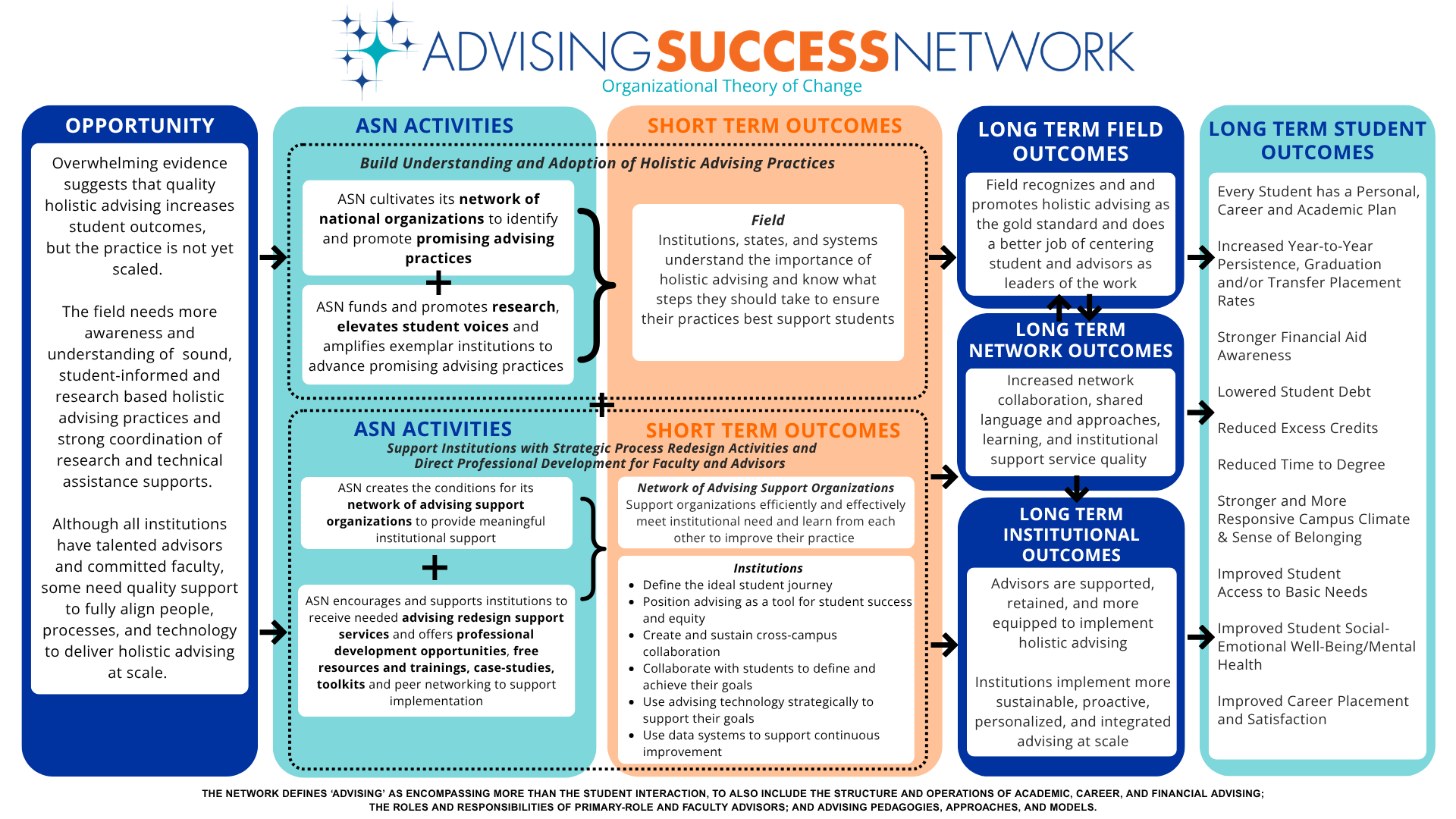
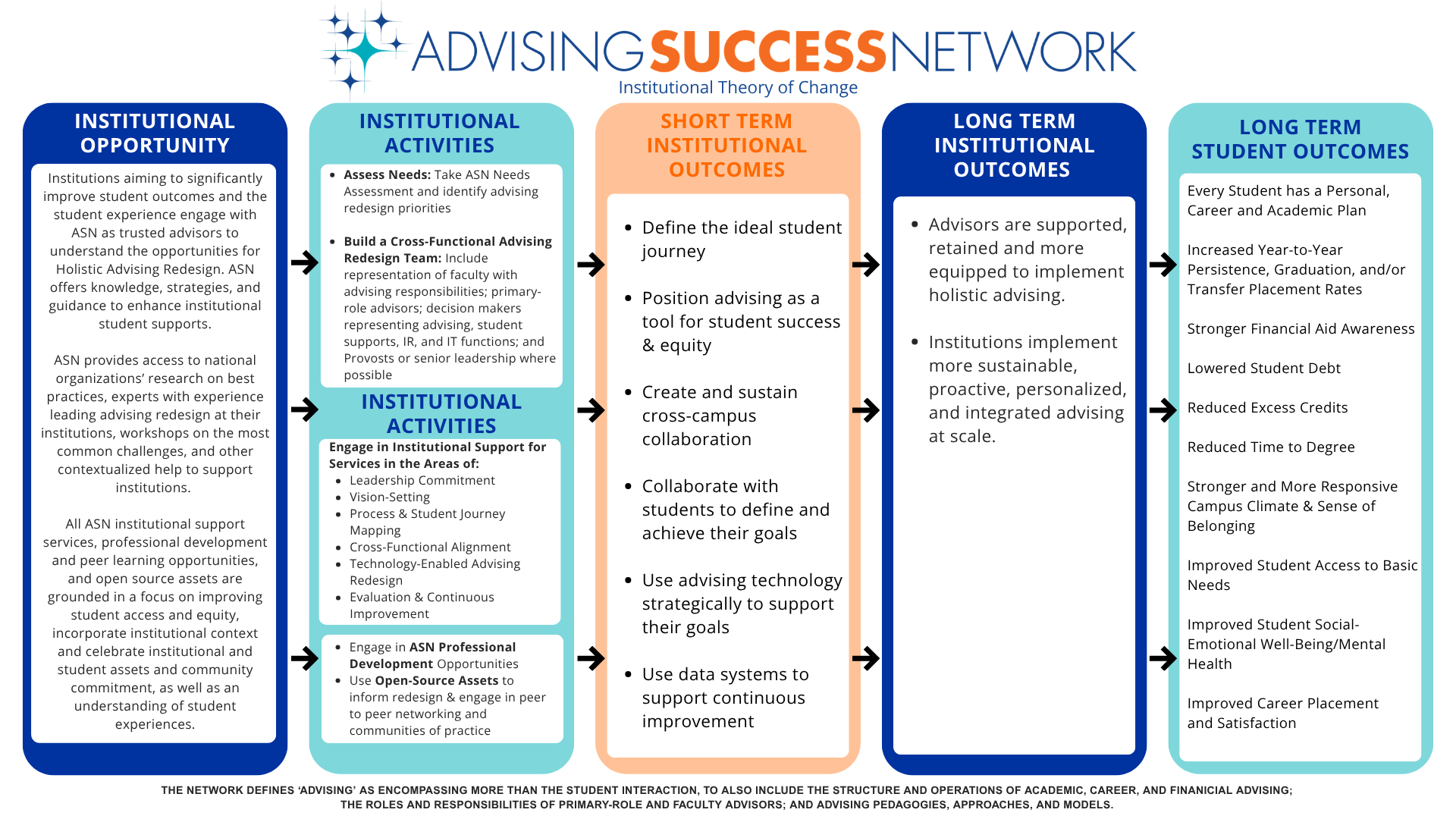
Institutional Theory of Change
This image shows how institutions partner with ASN to redesign advising by aligning people, processes, and technology through structured support, cross-functional collaboration, and continuous improvement. This work enables sustainable, proactive advising systems that improve student experience, progression, and long-term success.